How important is reading in personal growth
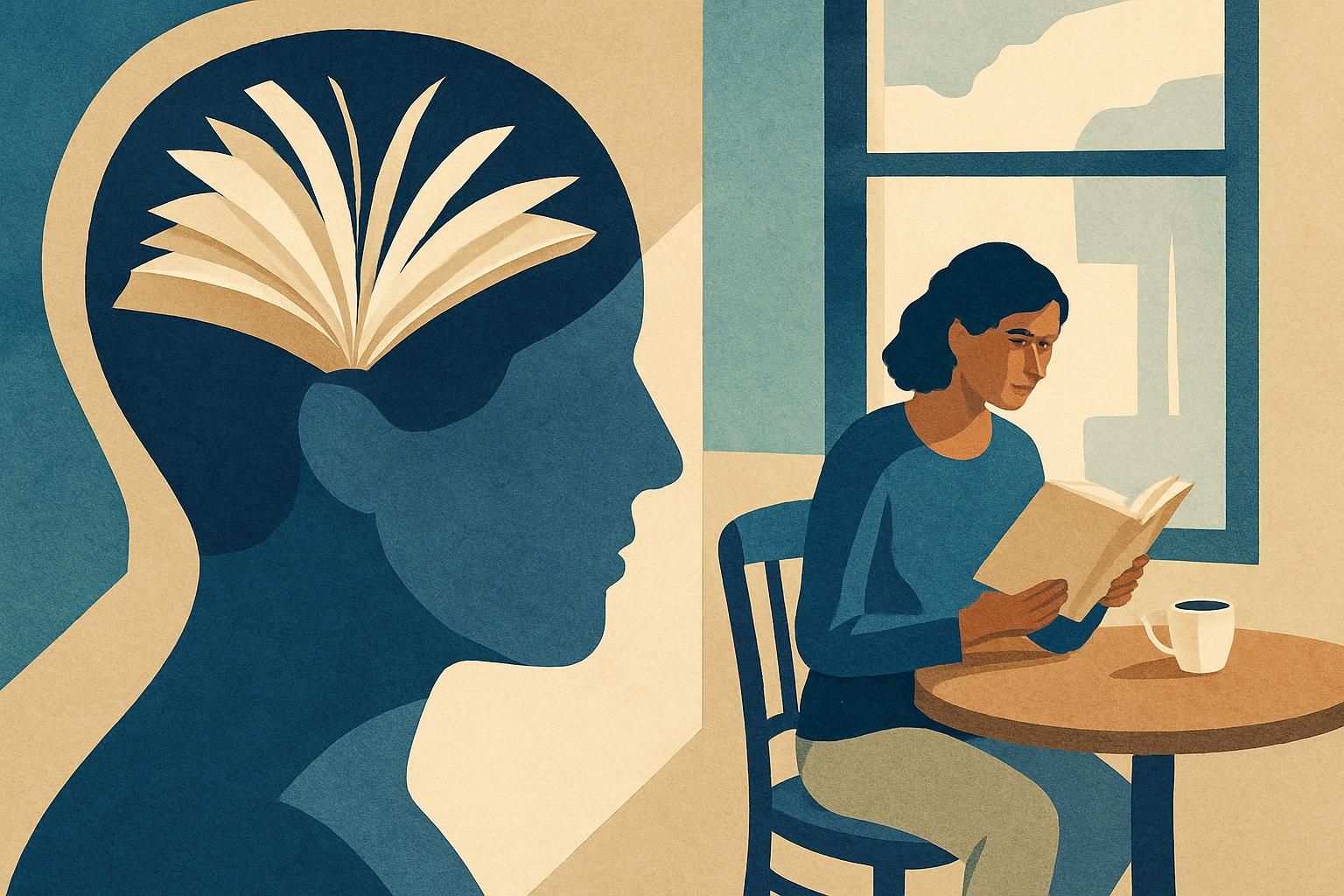
Reading is one of those habits that almost everyone agrees is good for you — and almost everyone finds reasons to postpone. But "it's good for you" is too vague to act on. What does reading actually do for personal growth, and how strong is the evidence? The honest answer is: quite a lot, across several dimensions of a well-lived life, though some of the research is stronger than others. Here is what we know, what we don't, and why the case for reading more is still compelling.
What research says reading does to your brain
Reading is one of the most complex cognitive tasks the brain performs. When you read, multiple neural systems activate simultaneously — those responsible for language processing, working memory, attention, and reasoning. That is a significant workout, and it compounds over time.
Studies suggest that regular intellectual engagement, including reading, helps build what researchers call cognitive reserve — the brain's resilience against age-related decline and neurological disorders such as Alzheimer's disease. People who engage in intellectually stimulating activities throughout life often maintain stronger cognitive functioning later in adulthood.
Perhaps the most striking piece of evidence involves not cognition but lifespan. A paper published in Social Science & Medicine in 2016 by Avni Bavishi, Martin Slade, and Becca Levy of the Yale School of Public Health used data from the US Health and Retirement Study. Participants reported how many hours they had spent reading books during the previous week, as well as time spent on newspapers and magazines. The researchers placed book reading into three groups: none, up to 3.5 hours per week, and more than 3.5 hours. Among the 3,635 Americans aged 50 and older, people who read books were less likely to die during the following 12 years than people who read none. Those reporting more than 3.5 hours of book reading a week had a 23 percent lower mortality hazard after adjustment for age, sex, race, wealth, education, health, and other measured differences.
It is worth being honest about what that finding does and does not mean. The study only shows an association between reading and long life, rather than a cause and effect. A later European analysis found no mortality link after its own corrections, and a 2022 systematic review of longitudinal research found generally favorable associations between leisure activities and cognitive outcomes, while stressing that results varied by activity, population, and cognitive measure. Most of the evidence remained observational. The Yale finding is intriguing and worth taking seriously — but treat it as motivation, not medical advice.
Critical thinking and problem-solving
Engaging in reading consistently bolsters cognitive processes by exercising the brain and enhancing critical thinking and analytical skills. Thinking through complex plots or understanding character motivations helps foster problem-solving skills, encouraging readers to make connections and draw conclusions.
Books promote what researchers call "deep reading" — a slow, immersive process of thoughtful and deliberate engagement. Deep reading not only enhances comprehension and enjoyment, but also promotes inferential and deductive reasoning, analogical skills, critical analysis, reflection, and insight. This may explain why book reading leads to improvements in vocabulary, reasoning, concentration, and critical thinking.
Students and adults alike are compelled to think deeply, critically, and analytically while reading, which helps them master higher-order thinking skills. They develop inferential skills, make connections between texts, and cultivate the ability to think about — and beyond — what is stated, based on evidence.
Empathy and emotional intelligence
One of the subtler benefits of reading is what it does to how you understand other people. One of the significant ways reading affects the brain is through perspective-taking. When you read and find yourself thinking about the characters as if they were real people with perspectives very different from your own, it allows for growth in emotional intelligence and empathy.
Studies reveal that reading literary fiction can improve both emotional empathy — feeling with others — and cognitive empathy, the ability to understand others' thoughts, feelings, and actions. Stories about the human condition help us recognize our common humanity and come to better understand others.
That said, the empathy effect is more nuanced than popular accounts suggest. Meta-analyses that pool the studies together find a modest, statistically real advantage for fiction reading on social-cognitive tasks, but the fair summary is not that a novel will turn you into a paragon of empathy — rather, that immersing yourself in other people's inner lives, page after page, plausibly exercises the same underlying capacities.
Vocabulary: the growth engine you don't notice
Reading is also the most natural and efficient route to a larger vocabulary — and a bigger vocabulary is not a trivial upgrade. Some researchers advocate that vocabulary is the most crucial factor in reading comprehension, arguing that no text comprehension is possible, either in one's native language or in a foreign language, without understanding the text's vocabulary.
Research by Nation and Waring (1997) found that native speakers can add about 1,000 word families a year to a vocabulary that already stands at around 20,000 word families — and much of that growth happens through reading, not deliberate study. The same dynamic applies to anyone learning a second language: each book you read at the right level embeds new words naturally, in context, with multiple exposures, which is precisely what makes them stick.
This is why the level at which you read matters. Nation (2001) notes that the probabilistic threshold for adequate comprehension is around 98% text coverage — with that coverage, almost all readers have a chance of gaining adequate comprehension. Reading texts that are slightly beyond your current vocabulary band is where growth happens; reading texts that are far beyond it is mostly frustration.
Learning across a lifetime — not just in school
There is a persistent myth that learning happens in formal education and growth happens afterwards. The reality is that the two are never separate. Reading is one of the most powerful tools for developing the mind, shaping identity, strengthening emotional intelligence, and enhancing long-term cognitive health. Across educational psychology, cognitive psychology, and neuroscience, research consistently shows that reading plays a critical role in intellectual development and psychological well-being — and the act of reading engages multiple cognitive systems simultaneously, promoting deeper thinking, emotional awareness, and personal reflection.
That means a degree, a diploma, or a certificate is a beginning, not an endpoint. Every field changes. Every profession accumulates new knowledge. Reading — whether in your speciality, adjacent to it, or far outside it — is how you stay genuinely current rather than merely experienced. The cost is low: a library card, a browser, or a reading app. The compounding returns over years are large.
How to make reading actually happen
Knowing reading is beneficial and actually reading consistently are different problems. A few approaches have reasonable evidence behind them:
- Read what interests you. Reading for pleasure is key to stimulating greater reading. Motivation drives frequency; frequency drives growth.
- Read at the right level. Material that is too easy builds fluency but adds few new words. Material that is too hard is discouraging and teaches little. Aim for texts where you understand most of the content but encounter a handful of new words per page.
- Read daily, even briefly. People who report as little as a half-hour a day of book reading had a significant survival advantage over those who did not read, according to the Yale researchers — though, as noted above, this is an association, not a prescription.
- Mix genres. Reading books that suit personal interests, or experimenting with other genres, helps maintain motivation. Fiction, self-help, and biography can all yield content that keeps readers engaged.
- Connect reading to community. Joining a book club or online reading community helps sustain motivation and creates opportunities to discuss ideas with people who share similar interests.
What reading cannot do
Reading is not a substitute for therapy, exercise, sleep, or real-world experience. Self-help books, in particular, are only useful if you act on them — insight without behaviour change is just entertainment. And not all reading is created equal: skimming social media posts does not produce the same cognitive engagement as working through a demanding book. The depth of the reading matters, not just the volume.
FAQ
Does it matter what type of books I read for personal growth?
Both fiction and non-fiction offer distinct benefits. Fiction is more strongly associated with gains in empathy and perspective-taking. Non-fiction — biography, history, popular science — builds knowledge and often models careful reasoning. The most useful approach is to read widely across both. What matters most is that you read regularly and at a level that challenges you slightly.
How much reading is enough to see real benefits?
The Yale research found that the more people read, the more likely they were to live longer, and just 3.5 hours a week was enough to make a measurable difference in the observational data. That works out to roughly 30 minutes a day — an achievable target for most adults. Consistency over years matters more than any single session.
Is reading on a screen as effective as reading print?
The research here is still developing. Some studies suggest that deep reading — the sustained, reflective kind linked to cognitive benefits — is slightly harder to sustain on screens, partly because digital environments carry more distractions. The device matters less than the quality of attention you bring. If you read carefully and without constant interruptions, the medium is secondary.
I finished my degree years ago. Is reading still relevant to my professional growth?
Yes, and arguably more so. Psychologists emphasise that lifelong learning is essential for maintaining psychological vitality and adaptability in a rapidly changing world. Every field evolves. Reading keeps your knowledge current, exposes you to adjacent ideas, and trains the critical thinking that formal education instils but that atrophies without practice.
Can reading really build empathy in adults, not just children?
Even though our emotional competence can benefit from reading at any age, starting readers young is crucial — but family reading plays a major role in a child's emotional intelligence development. For adults, the empathy gains are real but modest: consistent exposure to fiction, over time, is the mechanism. A single novel will not transform how you relate to others; a reading life sustained over years plausibly will.
Sources
- Reading and associations with brain health, cognition, well-being, and mental health — Psychological Medicine, Cambridge University Press (2025)
- Recreational book reading for promoting cognitive functioning and emotional well-being in older adults: A systematic review — PMC / Cochrane Protocol (2021)
- People who read books live almost 2 years longer — Science Alert summary of Bavishi, Slade & Levy, Yale School of Public Health, Social Science & Medicine (2016)
- Why reading is one of the best investments in personal growth you can make — Scandinavia Standard (2026)
- Lexical text coverage, learners' vocabulary size and reading comprehension — Laufer & Ravenhorst-Kalovski, Reading in a Foreign Language (2010)
- Reading fiction and reading minds: the role of simulation in the default network — PMC (2016)
- Why is reading important? The lifelong benefits of reading — 95 Percent Group (2025)
- Emotional intelligence: A key benefit of reading — Worldreader (2025)
If building a reading habit is something you are working on, Beeblio is designed to meet you exactly where you are. It measures which frequency band you can currently read comfortably, then offers short texts that sit just above that level — enough new vocabulary to grow, not so much that you lose the thread. When a word stops you, tap it: Beeblio turns it into a spaced-repetition card and resurfaces it until it sticks. Reading for personal growth works best when it is calibrated to your level. That is the problem Beeblio was built to solve.