Printable crossword puzzles for kids
A good crossword puzzle does something that a vocabulary list cannot: it makes a student produce a word, not just recognise it. That small difference — recall versus recognition — is why puzzle-based practice keeps showing up in classroom research as a genuine learning tool rather than merely a fun time-filler. The five free printable crosswords below are pitched at middle school students (roughly grades 6–8), cover five different subject areas, and are ready to print and hand out right now. Before you scroll down, it is worth spending two minutes on the "why," because understanding the mechanism will help you use these puzzles more effectively.
Why crossword puzzles are more than busywork
The core reason crosswords work is retrieval practice. When students actively retrieve information from memory, they reinforce existing retrieval routes and establish new ones — a process that strengthens memory and facilitates better long-term retention of the material. A crossword forces that exact process: the student reads a clue, searches memory, and produces an answer letter by letter. That is the same cognitive operation an exam requires — not recognising information on a page, but producing it from scratch.
Several studies on vocabulary in particular support this. A study examining the effects of crossword puzzles on vocabulary acquisition found that students' post-test scores were significantly higher than their pre-test scores, and that students across all proficiency groups improved at a significance level of 0.05. Students also reported very favourable attitudes toward learning vocabulary through crosswords, and the conclusion was that crosswords can improve vocabulary knowledge while increasing motivation.
Two further benefits are worth naming honestly. First, accuracy matters in a grid: a single misspelled word can throw off an entire crossword, because every letter has to line up with the words crossing it — which naturally teaches kids the value of accurate spelling. Second, solving crosswords requires active retrieval of information, which strengthens neural connections and supports long-term retention, and is particularly effective for learning technical terms in science, technology, engineering, and mathematics fields.
A fair caveat: a systematic review identified that many studies on crosswords have assessed outcomes based on student perceptions and self-assessed improvements rather than objective measures of learning, and self-reported confidence is a weak surrogate for actual academic achievement. That is worth keeping in mind. Use these puzzles as one practice format among several, not as a replacement for direct instruction or varied assessment.
How to use these printables effectively
Puzzles tailored to specific topics or curriculum objectives allow students to review and apply what they have learned in a novel and engaging format. The five puzzles below are each tied to a distinct school subject, which means you can slot them in immediately after a relevant unit rather than using them as generic filler. Here are three practical tips:
- Sequence them after teaching, not before. A crossword tests recall; it cannot replace initial instruction. Use it the day after a lesson or at the end of a unit.
- Try pair work first. Solving puzzles like crosswords requires patience, persistence, and resilience. Students learn to tackle challenges methodically, persisting through setbacks and refining strategies until they reach a solution — which fosters a growth mindset. Pair work lowers the barrier for students who feel stuck without removing the productive struggle.
- Review answers aloud. Feedback is an important part of retrieval practice — it lets learners know about any errors and helps prevent accidentally encoding the wrong material into memory.
The five free printable crosswords
Each puzzle below is described with the number of clues and the main vocabulary students will encounter. All five are free to download and print.
1. Bodies of Water crossword
Download Printable Crossword 1 — Bodies of Water (JPG)
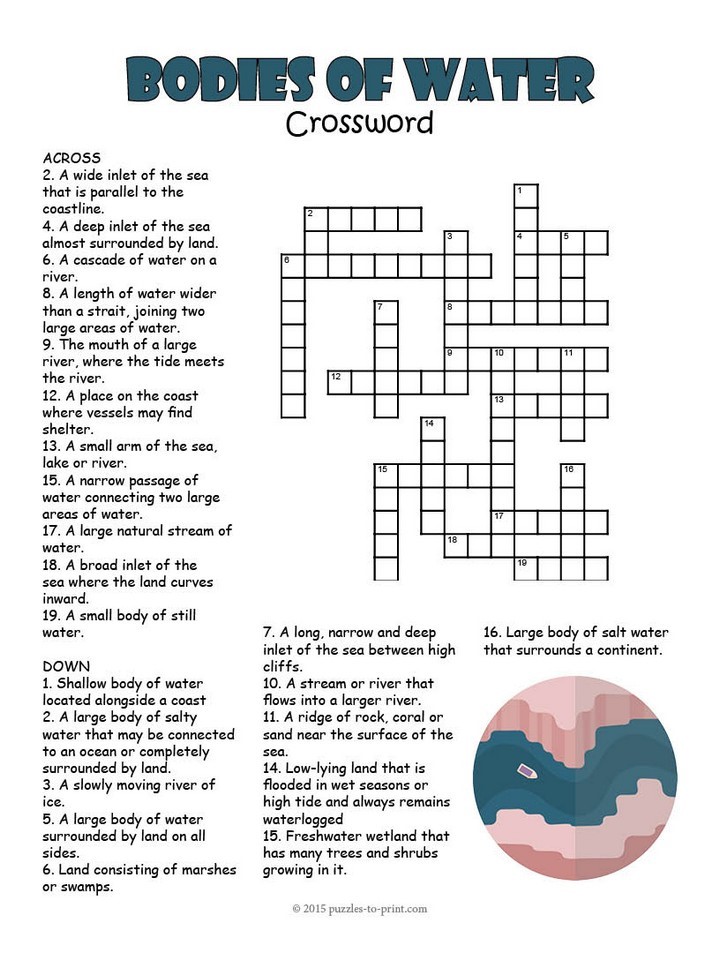
This is the most geographically focused puzzle in the set. Students must name 18 distinct bodies of water — oceans, seas, gulfs, bays, straits, rivers, and lakes — using contextual hints rather than a word bank. Because no answer list is provided, students have to draw on prior knowledge or look terms up, making this a good companion to an Earth science or world geography unit. Words students are likely to encounter include:
- terms for large saltwater bodies (ocean, sea, gulf)
- terms for connecting or partially enclosed waters (strait, bay, fjord)
- freshwater categories (river, lake, reservoir, tributary)
- named examples from world geography
Difficulty: challenging — best suited to grades 7–8, or grade 6 students who have just finished a geography unit.
2. Chemistry crossword
Download Printable Crossword 2 — Chemistry (PNG)
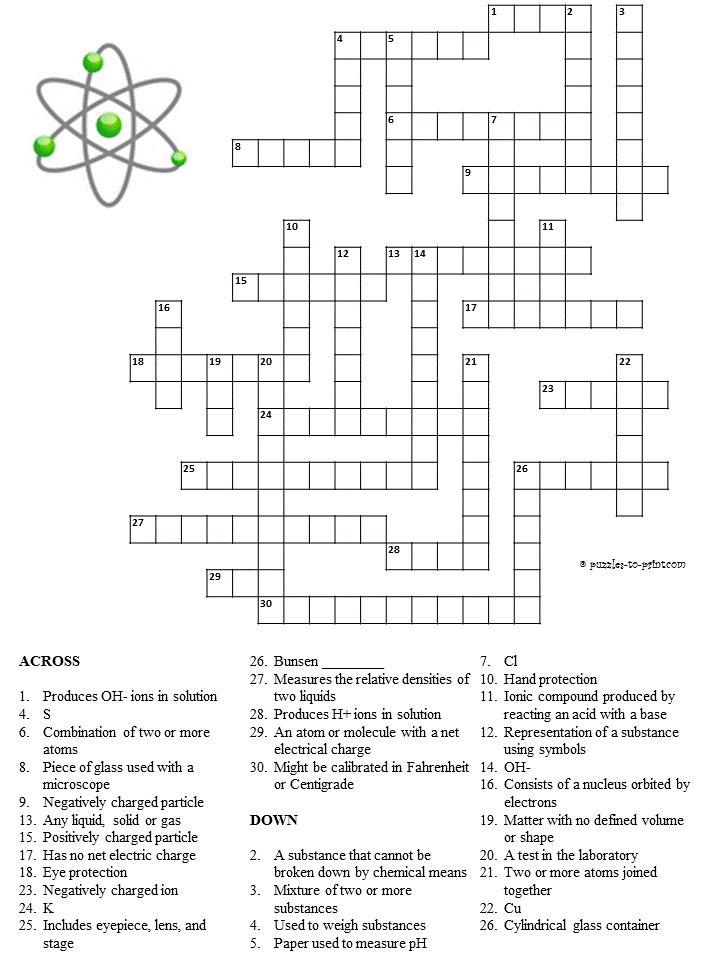
With 32 clues, this is the longest puzzle in the set and will take most students 30–45 minutes. Crossword games built around fundamental chemistry concepts — such as elements, symbols, and atomic structure — spark curiosity and deepen scientific knowledge, promoting better retention in a fun, stress-free environment. Expect clues covering:
- states of matter and physical vs. chemical change
- atomic structure (proton, neutron, electron, nucleus)
- basic bonding and reaction vocabulary (compound, mixture, solution)
- element names and symbols from the first few periods of the periodic table
Difficulty: challenging — ideal as a unit review activity after covering introductory chemistry.
3. The First Forty Elements crossword
Download Printable Crossword 3 — First Forty Elements (PNG)
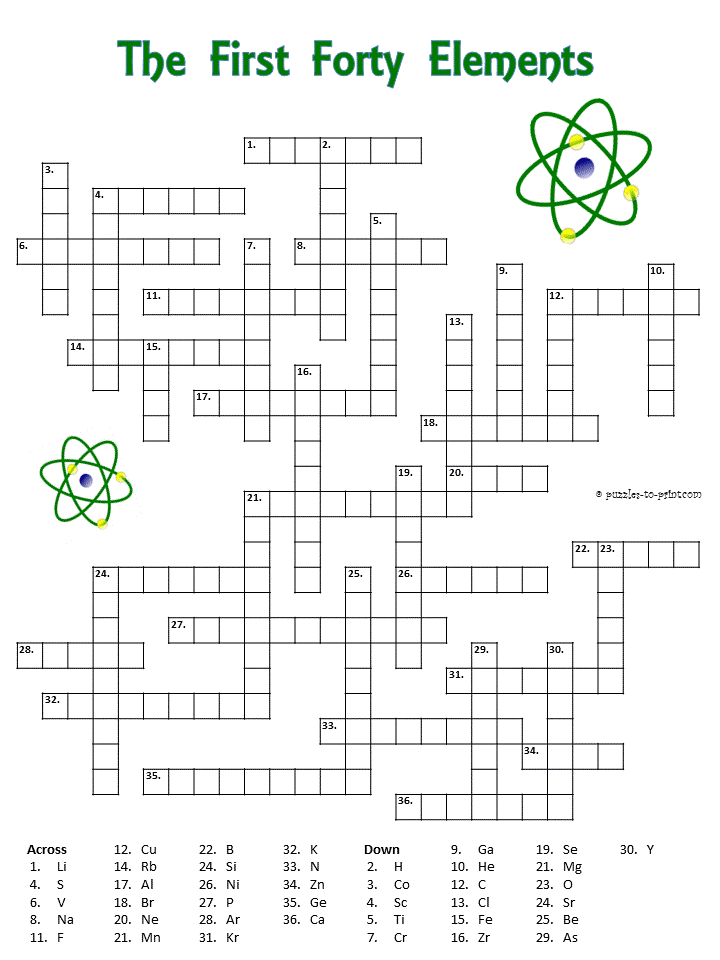
This puzzle focuses exclusively on the periodic table, asking students to recall the names of the first 40 elements from their symbols, atomic numbers, or a brief descriptive clue. It pairs perfectly with the Chemistry crossword above, or can stand alone as a memorisation drill. Below is a reference table of the 40 elements covered:
| No. | Symbol | Element | No. | Symbol | Element | No. | Symbol | Element | No. | Symbol | Element |
|---|---|---|---|---|---|---|---|---|---|---|---|
| 1 | H | Hydrogen | 11 | Na | Sodium | 21 | Sc | Scandium | 31 | Ga | Gallium |
| 2 | He | Helium | 12 | Mg | Magnesium | 22 | Ti | Titanium | 32 | Ge | Germanium |
| 3 | Li | Lithium | 13 | Al | Aluminium | 23 | V | Vanadium | 33 | As | Arsenic |
| 4 | Be | Beryllium | 14 | Si | Silicon | 24 | Cr | Chromium | 34 | Se | Selenium |
| 5 | B | Boron | 15 | P | Phosphorus | 25 | Mn | Manganese | 35 | Br | Bromine |
| 6 | C | Carbon | 16 | S | Sulfur | 26 | Fe | Iron | 36 | Kr | Krypton |
| 7 | N | Nitrogen | 17 | Cl | Chlorine | 27 | Co | Cobalt | 37 | Rb | Rubidium |
| 8 | O | Oxygen | 18 | Ar | Argon | 28 | Ni | Nickel | 38 | Sr | Strontium |
| 9 | F | Fluorine | 19 | K | Potassium | 29 | Cu | Copper | 39 | Y | Yttrium |
| 10 | Ne | Neon | 20 | Ca | Calcium | 30 | Zn | Zinc | 40 | Zr | Zirconium |
Difficulty: moderate to challenging — the early elements are widely known; the transition metals from 21 onwards are where students will genuinely be stretched.
4. Our Solar System crossword
Download Printable Crossword 4 — Our Solar System (PNG)
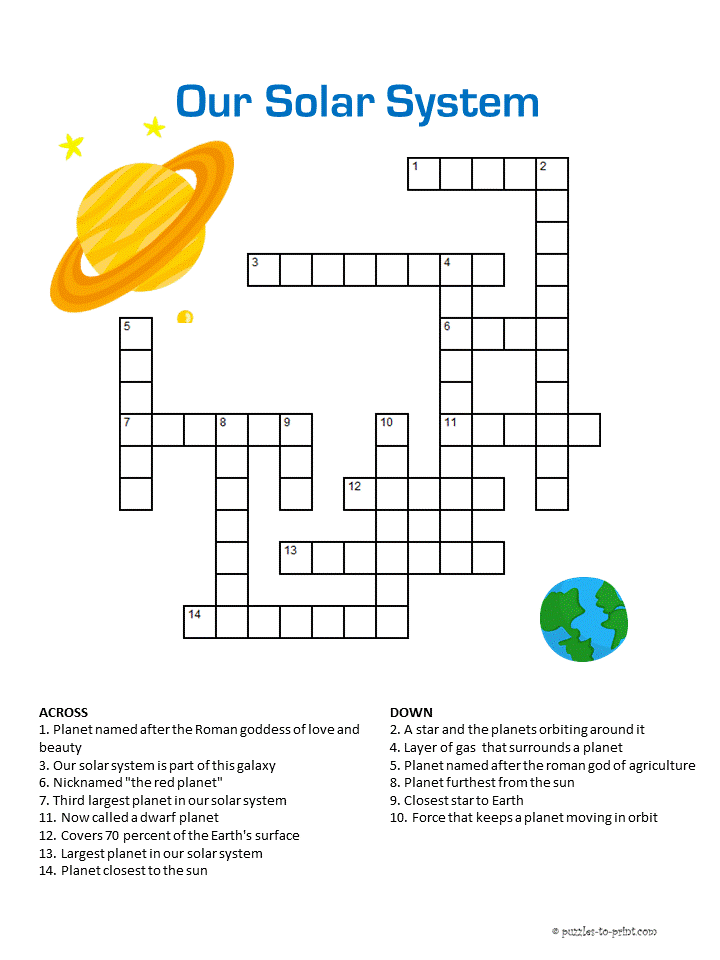
Fourteen clues take students through the essential vocabulary of the solar system: planet names, defining features (rings, moons, size, position), and key terms such as orbit, asteroid, comet, dwarf planet, and astronomical unit. The relatively compact size makes this the fastest puzzle in the set — a good warm-up or end-of-lesson activity for a space science unit.
Difficulty: moderate — accessible to grades 6 and above.
5. State Capitals crossword
Download Printable Crossword 5 — State Capitals (JPG)
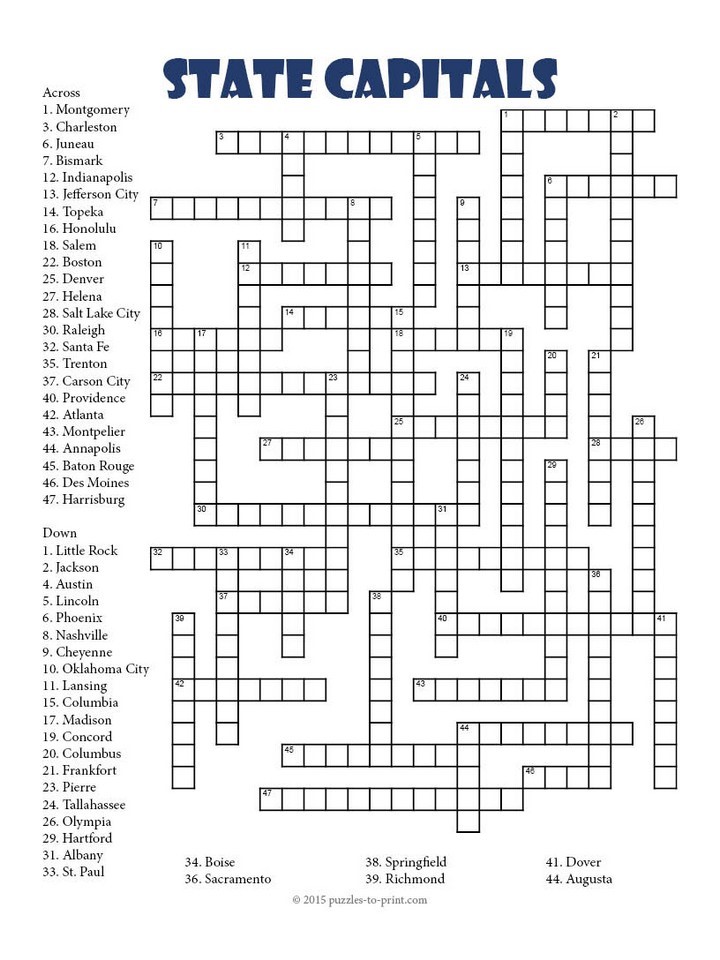
The most demanding geography puzzle here: 47 clues, one for every state whose capital needs to be placed in the grid (three states share the same capital name length in the grid construction, so not all 50 appear as separate entries). Students who already know common capitals such as Austin, Albany, and Sacramento will find the real challenge in less-tested ones — Frankfort (Kentucky), Montpelier (Vermont), and Pierre (South Dakota) reliably trip up even confident students. This puzzle works equally well as a revision tool or a friendly competition between pairs.
Difficulty: challenging — best placed after a U.S. geography unit rather than before it.
FAQ
What grade level are these crossword puzzles designed for?
Middle school crossword puzzles are built for kids in grades 6, 7, and 8, challenging pre-teens to use context clues, decode word meanings, and practise correct spelling across core subjects. Unlike early childhood puzzles, they feature multi-layered clues tailored for the 11-to-14 age group. The solar system puzzle (14 clues) is accessible at the younger end of this range; the chemistry and state capitals puzzles (32 and 47 clues respectively) suit grades 7–8 or advanced grade 6 students.
Should I give students an answer key?
Yes — but time it carefully. Handing out the key before students have genuinely attempted the puzzle eliminates the retrieval practice benefit entirely. A better approach is to let students work independently or in pairs first, then review answers together as a class. Feedback is an important part of retrieval practice: it lets learners know about any errors they made and helps prevent accidentally encoding incorrect information into memory.
Can these be used as a formal assessment?
Puzzles can serve as formative or summative assessment tools to gauge students' understanding of lesson concepts — students can complete them individually or in pairs as a way to demonstrate comprehension. That said, a crossword only tests whether a student can recall a specific word given a specific clue. It cannot assess extended writing, analysis, or reasoning. Use it as one data point, not the whole picture.
What if a student gets completely stuck?
While some students may find the format initially challenging, proper guidance and practice can maximise its educational benefits. Practical strategies: encourage students to fill in any answers they are confident about first (crossing letters often unlock stalled clues), allow dictionary use for the Bodies of Water and Chemistry puzzles, or provide a word bank for struggling students while removing it for stronger ones.
Are there good free tools for making custom crosswords?
Yes. Puzzle Maker (Discovery Education) and Crossword Labs are both free, require no account for basic use, and let teachers enter their own word lists and clues. This means you can build a crossword matched exactly to the vocabulary in your current unit — the most educationally effective approach, since puzzles tailored to specific topics or curriculum objectives allow students to review and apply what they have learned in a novel and engaging format.
Sources
- Orawiwatnakul, W. (2013). Crossword Puzzles as a Learning Tool for Vocabulary Development. Electronic Journal of Research in Educational Psychology, 11(2), 413–428.
- Edutopia (2025). Quick and Mighty Retrieval Practices.
- Washington University in St. Louis Center for Teaching and Learning. Using Retrieval Practice to Increase Student Learning.
- Improving learning outcomes through classroom-based gamified crossword puzzle activities. PubMed Central, 2025.
- Your Thrifty Co-Teacher (2024). Benefits of Word Searches & Crossword Puzzles for Kids.
- Middle School Crossword Puzzles: Free Printable for Grades 6–8.
Once students finish one of these puzzles, several of the words they just retrieved will be new to them — precisely the kind of vocabulary that sits just beyond their current reading level. That is exactly the territory Beeblio targets: short readings calibrated to the words a learner already knows, with a handful of new words woven in and queued for spaced-repetition review. If a student found tributary, astronomical unit, or Frankfort unfamiliar today, those make natural first cards.